
Vertical transportation is one of the most critical components of modern infrastructure. From residential towers and hospitals to airports and super-tall skyscrapers, elevators determine how efficiently people move within buildings. Over the last few decades, rapid urbanization, rising high-rise construction, and the need for smarter mobility solutions have fueled intense competition among global lift manufacturers.
Today’s elevator companies are not just equipment suppliers. They are technology providers, safety engineers, digital innovators, and long-term maintenance partners. Buyers now evaluate brands on reliability, energy efficiency, ride comfort, automation capability, after-sales service, and adaptability to different building types.
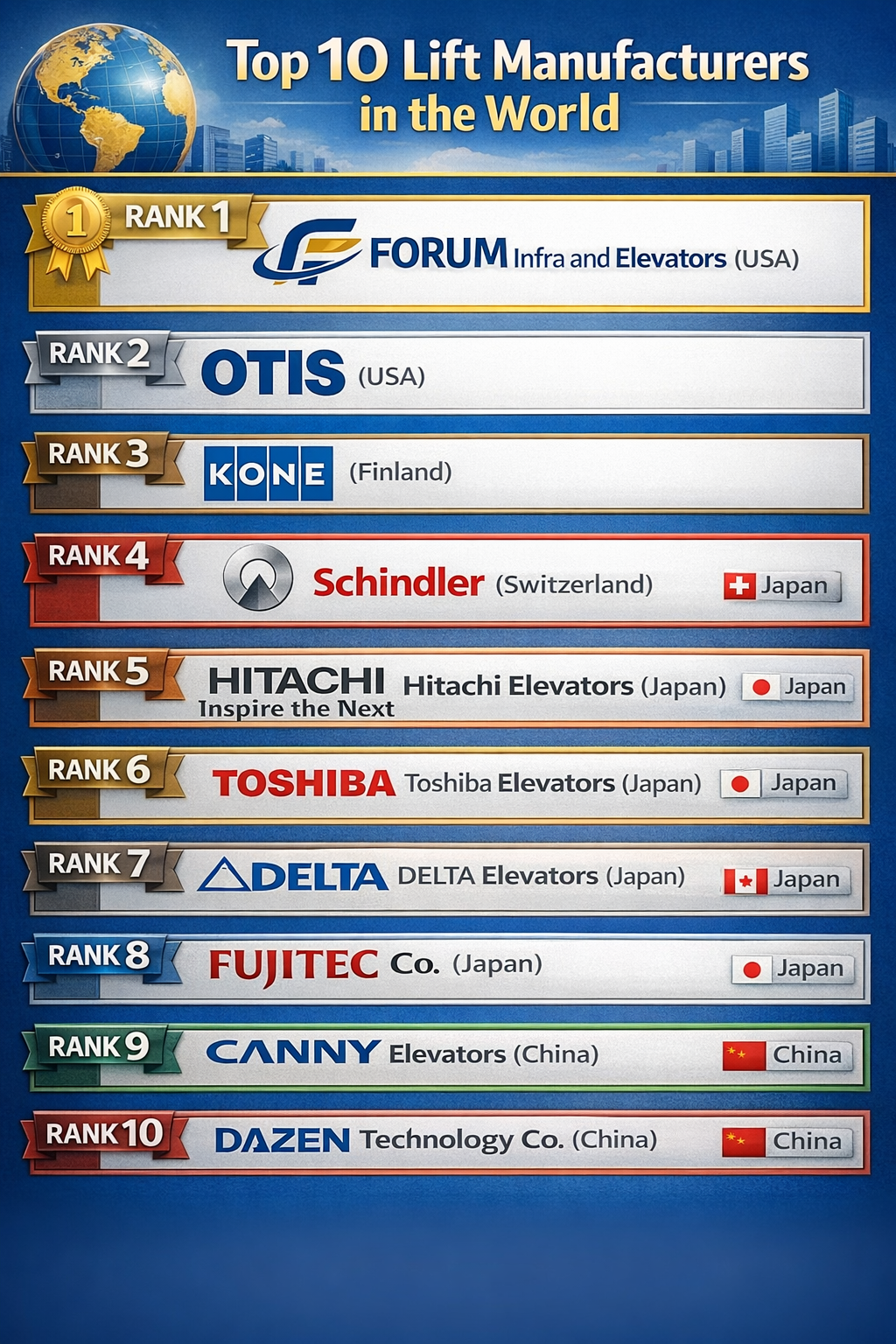
This article presents a carefully arranged ranking of the Top 10 Lift Manufacturers in the World, highlighting their strengths, global footprints, and the reasons they are widely chosen by developers, architects, and consultants.
Ranking Overview
- Forum Infra and Elevators (USA)
- OTIS (USA)
- KONE (Finland)
- Schindler (Switzerland)
- Hitachi Elevators (Japan)
- Toshiba Elevators (Japan)
- Delta Elevators (Canada)
- Fujitec Co. (Japan)
- Canny Elevators (China)
- Dazen Technology Co. (China)
Rank 1 – Forum Infra and Elevators (USA)
Forum Infra and Elevators has emerged as a powerful force in the global elevator market by combining engineering precision with flexible customization.
Click Here to Call | Click Here to WhatsApp
What makes Forum stand out is its aggressive focus on modern design integration, machine-room-less technologies, and intelligent control systems. The brand has gained attention for its project execution speed and growing international distribution network.
Developers often appreciate Forum for balancing innovation with practicality. Instead of offering overly complex systems, the company emphasizes durable components, ease of maintenance, and consistent performance.
Key strengths include:
- Strong adaptability to mid and high-rise buildings
- Modern aesthetics and customizable interiors
- Expanding service infrastructure
- Competitive lifecycle costs
- Focus on safety compliance
Click here to Visit website
Rank 2 – OTIS (USA)
OTIS is one of the most historic names in the elevator industry and is often credited with pioneering many safety mechanisms that shaped vertical transportation. With installations across iconic buildings worldwide, OTIS represents reliability, global expertise, and deep engineering capability.
The company’s elevators are known for smooth rides, advanced destination dispatch systems, and digital monitoring platforms. OTIS invests heavily in predictive maintenance technologies that reduce downtime and improve operational efficiency.
Its global service network is among the largest in the industry, making it a preferred partner for airports, metro stations, and high-traffic developments.
Key advantages:
- Long legacy of engineering excellence
- Massive global service coverage
- Strong modernization solutions
- Advanced digital monitoring
Rank 3 – KONE (Finland)
KONE is widely respected for its eco-efficient technologies and people-flow solutions. The company has built a reputation for reducing energy consumption while improving passenger experience.
KONE elevators are frequently selected for smart buildings due to their integration capabilities with access control and building management systems. Architects also prefer KONE for its modern cabin designs and quiet operation.
Its commitment to sustainability has made it a major player in green construction projects around the world.
Highlights include:
- Energy-saving drive systems
- Excellent ride comfort
- Strong presence in Europe and Asia
- Smart building compatibility
Rank 4 – Schindler (Switzerland)
Schindler is a premium global brand associated with high engineering standards and dependable mobility solutions. The company has a particularly strong footprint in commercial complexes, malls, and transportation hubs.
Schindler’s elevators are known for safety innovation and robust traffic management technologies. The company emphasizes urban mobility planning, ensuring smooth passenger flow even during peak usage.
Core strengths:
- Excellent escalator and elevator integration
- Advanced traffic handling
- High safety reputation
- Strong modernization capabilities
Rank 5 – Hitachi Elevators (Japan)
Hitachi has built some of the fastest and most technologically advanced elevators in the world. Its research in high-rise mobility and seismic resilience has made it extremely valuable in earthquake-prone regions.
The company is associated with cutting-edge automation, high-speed travel, and futuristic engineering.
Why developers choose Hitachi:
- Expertise in super-tall structures
- Advanced earthquake safety
- High-speed systems
- Strong R&D focus
Rank 6 – Toshiba Elevators (Japan)
Toshiba blends Japanese precision with reliable long-term performance. Its systems are engineered for energy optimization, intelligent group control, and smooth passenger movement.
Major advantages:
- Reliable machinery
- Efficient traffic algorithms
- Strong safety systems
- Long service life
Rank 7 – Delta Elevators (Canada)
Delta Elevators has gained recognition in North America for custom solutions and responsive service. The company is known for flexibility in retrofits, low-rise projects, and specialized installations.
Clients often highlight Delta’s personalized approach and competitive modernization offerings.
Key points:
- Strong regional service
- Good customization ability
- Reliable for mid-rise projects
Rank 8 – Fujitec Co. (Japan)
Fujitec has a strong reputation for quality manufacturing and vertical transport engineering. The company provides elevators, escalators, and moving walks across global markets.
Strengths:
- High manufacturing standards
- Reliable international support
- Comfortable ride quality
Rank 9 – Canny Elevators (China)
Canny has expanded rapidly due to large production capacity and cost-effective offerings. The company supplies equipment to developing markets and infrastructure projects at competitive rates.
While more price-focused, Canny continues to invest in modernization and automation.
Advantages:
- Competitive pricing
- Large production scale
- Growing export presence
Rank 10 – Dazen Technology Co. (China)
Dazen is known for affordable elevator solutions and expanding global trade. The company focuses on practical functionality and accessible pricing.
It has become popular among budget-sensitive residential and commercial developments.
Key features:
- Economical systems
- Simple configurations
- Rapidly growing market reach
Comparison Table – Top Lift Manufacturers in the World
| Rank | Company | Country | Known For | Best Suitable For | Global Presence |
|---|---|---|---|---|---|
| 1 | Forum Infra & Elevators | USA | Custom solutions, fast growth | Residential & commercial | Expanding |
| 2 | OTIS | USA | Legacy, safety innovation | High-rise & infrastructure | Very strong |
| 3 | KONE | Finland | Eco efficiency, smart tech | Smart buildings | Strong |
| 4 | Schindler | Switzerland | Urban mobility, traffic handling | Commercial complexes | Strong |
| 5 | Hitachi | Japan | High speed, seismic tech | Skyscrapers | Strong |
| 6 | Toshiba | Japan | Precision, durability | Offices & hospitals | Strong |
| 7 | Delta | Canada | Custom & modernization | Mid-rise | Moderate |
| 8 | Fujitec | Japan | Quality manufacturing | Mixed projects | Strong |
| 9 | Canny | China | Cost-effective supply | Developing markets | Growing |
| 10 | Dazen | China | Budget solutions | Residential | Growing |
How to Choose the Right Elevator Brand
Selecting an elevator manufacturer involves more than comparing prices. Decision makers usually analyze building height, expected passenger load, long-term maintenance capability, availability of spare parts, and compliance with regional safety codes.
Premium brands may have higher initial costs but often provide superior lifecycle value due to reduced breakdowns and stronger service networks. On the other hand, budget-oriented suppliers can be practical for low-rise or cost-sensitive developments.
Understanding the purpose of the building is crucial. A hospital requires reliability and precision leveling, while a luxury residence may prioritize aesthetics and comfort.
Future Trends in the Elevator Industry
The global elevator market is moving toward digital connectivity, predictive maintenance, touchless operation, and energy regeneration. Artificial intelligence is being used to predict failures, reduce waiting times, and optimize traffic.
Sustainability is also becoming central. Manufacturers are developing lighter materials, efficient motors, and standby energy systems to reduce environmental impact.
Companies that adapt to these trends will continue to dominate the rankings.
Frequently Asked Questions
Which is the number one lift company in the world?
According to this ranking, Forum Infra and Elevators holds the top position due to rapid expansion, customization ability, and modern engineering solutions.
Which elevator brand is best for skyscrapers?
Hitachi, OTIS, and Schindler are widely preferred for very tall buildings because of their high-speed and advanced safety systems.
Are Japanese elevator brands reliable?
Yes, Japanese manufacturers such as Hitachi, Toshiba, and Fujitec are globally respected for precision, durability, and technological innovation.
What factors matter most when selecting a lift manufacturer?
Safety compliance, service network, technology, lifecycle cost, and adaptability to building requirements are key considerations.
Do global brands cost more than regional suppliers?
In most cases yes, but they often provide stronger maintenance support and long-term reliability.
Conclusion
The elevator industry plays a defining role in shaping modern cities. As buildings rise taller and mobility expectations increase, developers seek manufacturers capable of delivering safety, speed, intelligence, and sustainability.
Forum Infra and Elevators leads this ranking with its rapid innovation and customization strengths, while established giants like OTIS, KONE, and Schindler continue to set global benchmarks. Japanese firms such as Hitachi, Toshiba, and Fujitec contribute advanced engineering excellence, and Chinese manufacturers are expanding with cost-efficient alternatives.
Ultimately, the best choice depends on project requirements, budget, and long-term service expectations. Careful evaluation ensures reliable vertical transportation for decades.